
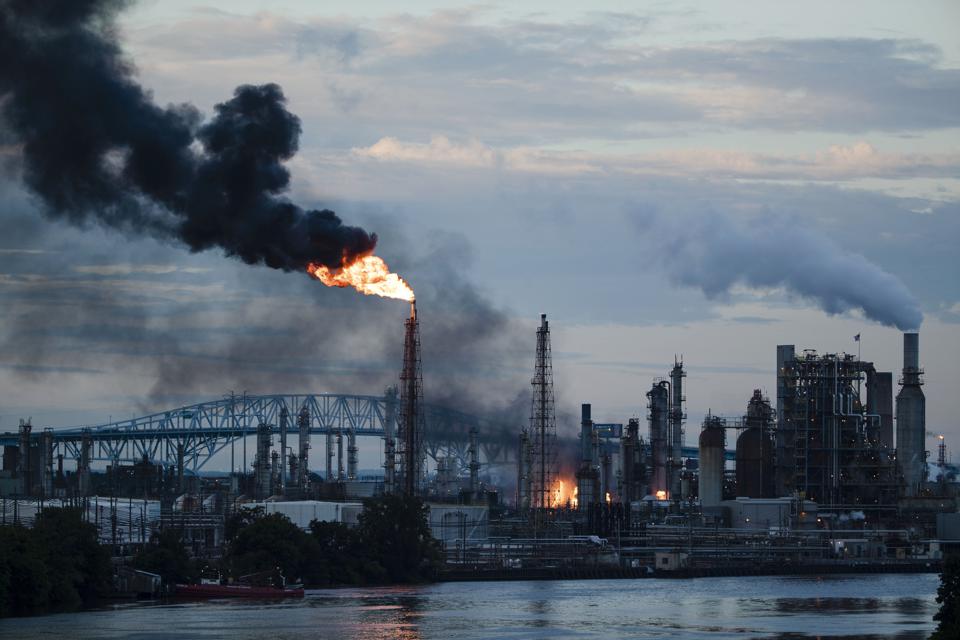
Whenever I would travel across the Schuylkill River in the great city of brotherly love, it would feel like I was entering a scene of a horror film. Looking out the window from the Girard Point Bridge, I’d see smoke coming out of enormous gas plants, creating a dark, gloomy, foggy view. And there I would see a massive dark cloud above the entire plant –1,300 acres of it to be exact.
Little did I know that I was looking at the oldest and largest oil refinery in the entire East Coast. And little did I know that this huge chunk of metal was the leading cause of respiratory illnesses and safety hazards in nearby communities for over a century.
This, once known as Philadelphia Energy Solutions Refinery Complex (PES), is responsible for polluting South Philly, disproportionately threatening generations of resident’s lives, and is just another reason as to why fossil-fuel driven economies never have the public’s best interest. Asthma rates in surrounding neighborhoods would be four times the national rate and double the city’s average.
For years, PES would generate gasoline from taking Bakken Shale from North Dakota, and in June 2019, the 157-year-old refinery exploded, releasing 5.239 pounds of deadly chemicals.
“This blew up and could have killed people and I have the right to know what’s going on.” – local resident.
This is environmental racism – oil and gas industries targeting vulnerable, underrepresented neighborhoods and using communities of low-income and color to strategically design/operate their poisonous and life-threatening gas plant for profit. It is why we say pollution in this country is segregated and is rooted from centuries of systematic racism.
PhillyThrive is an environmental justice grassroot organization established in 2015 to fight for the ‘Right to Breathe’ in Philadelphia. This organization made up of residents directly impacted by the refinery, was the driving force in removing PES from their neighborhood.
“As someone who lives here, as someone who lives near the refinery, ain’t no one did anything for this community until PhillyThrive came along,” – PhillyThrive member.
Not long after the explosion, Hilco Redevelopment Partners purchased the site and their redevelopment plan is to build giant warehouses. Keep in mind, the thought of residential development in this location was not an option. Why? The soil was too contaminated for it to reverse to its natural state. That can give you an idea of how toxic the refinery was to not only people’s health, but the land as well – and its contribution to climate change.
Evergreen Resources Group, LLC, the company managing the clean-up of the site, held a public forum to address their plan. Following the forum, I talked to PhillyThrive members who felt the meeting was uninformative and inaccessible to their community.
“It was really frustrating for me. They referred to us as receptors. I am a person. I am a human being. I am a member of this community. I was totally disappointed by this process. It’s about listening to my voice and talking to me in my voice. As an organization, we have work we’re going to do, in terms of letting people know exactly what is happening.” – Mark Clincy/Thrive member.
Though PES is gone, the next steps are important to ensure the safety of nearby communities who are already carrying the burden from the health effects of the oil refinery.
“It’s just as frustrating and just as important. This site is a multi-generational issue, we’re talking about more than five generations of environmental racism that has come before this. And now we’re seeing this site transition into a new use. What’s being done now, particularly with the cleanup is going to impact people of this community for generations to come. We’re recognizing how important that is and how the site is tied through the fossil fuel industry historically and how climate change is going to have an impact on how the site should be cleaned up to protect the health of everybody in the community. In some cases, we are being left out of the process,” said James Mullison/Thrive member
As one with friends/colleagues residing in this community, it is frustrating to witness the effects this fossil fuel industry has on the Black community and to have friends with respiratory illnesses because of it. However, it is inspiring to see the power of what grassroot organizing can do. There was very little political affiliation in the process of removing the refinery in the past five years. PhillyThrive was the blueprint of this movement. Now, the fight is to have a permanent seat at the table when decisions are being made on redevelopment.
Though it is great to see PES officially shut down, we must address the damage that was already done. Generations of residents have suffered and inherited respiratory diseases under PES. And replacing it isn’t going to erase that. The removal of PES doesn’t mean those with lung cancer, asthma and other illnesses will just disappear.
The question is how should we hold this industry accountable for threatening public safety/health? What reparations need to be implemented to give families a chance to recover from the trauma? There are physical, financial, and mental impacts connected to this and those factors need to be considered when having these conversations. It’s unfair and unethical for this refinery to just get up and move after all the damage it caused for the past 157 years. Supporting vulnerable communities and grassroot organizations for environmental and social change is essential to move forward as a society. Unfortunately, what we’re seeing here in South Philly is happening in numerous communities of low-income and color across the nation. And giving them a seat at the table is the first step in changing that.
“Nobody could say they would have done this to another community, yet they felt like it was okay to do this to us. Suppose it was your child, your parent, your family living under these conditions, how would you feel about that?” – Clincy

